The problem
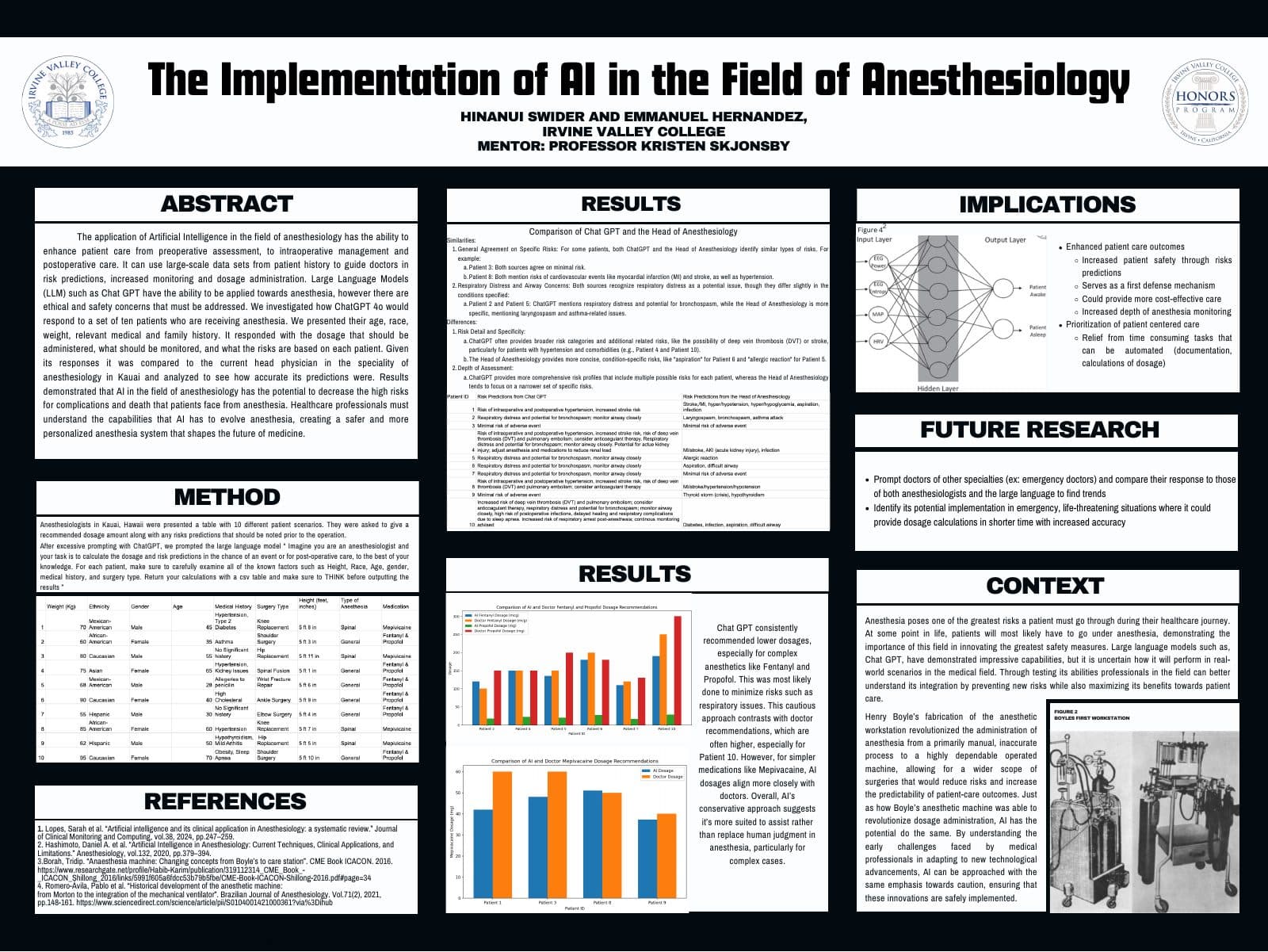
Getting anesthesia dosage wrong is catastrophic either way. Too little and a patient can wake up mid-surgery; too much and you risk respiratory failure. Anesthesiologists factor in weight, height, age, comorbidities, surgery type, and medication history all at once. We wanted to see how close a large language model could get, and what it would miss.
What we did
We gave GPT-4o 10 real patient profiles and told it to act as an anesthesiologist: output a recommended dosage and flag any risks. Then we compared every prediction against what the head anesthesiologist in Kauai, HI actually charted for the same patients.
What we found
- 01AI agreed on major risk categories but named them broadly; doctors flagged specific conditions like "aspiration risk" for individual patients
- 02ChatGPT recommended lower doses across the board, especially for Fentanyl and Propofol
- 03For complex patients with multiple comorbidities, AI was more cautious than clinical judgment warranted
- 04Best use case is first-pass monitoring and documentation, not replacing surgical decision-making
In more detail
Method
Each patient had weight, height, age, ethnicity, medical history, and surgery type. We prompted GPT-4o to act as an anesthesiologist and return dosage recommendations and risk predictions, then compared every output against the specialist's actual clinical notes.
Results: dosage
ChatGPT consistently went lower on doses than the doctors did, especially for Fentanyl and Propofol. For straightforward cases that was fine. For patients with multiple comorbidities, the AI was being too cautious in ways that a real anesthesiologist would not.
Results: risk
Both agreed on the big categories like cardiovascular and respiratory risks. The difference was specificity. Anesthesiologists named exact conditions like "aspiration risk" for a specific patient. AI gave broader flags that applied to multiple patients at once.
Implications
AI is not replacing anyone here. But it has a real use case as a first-pass tool: flagging risks across large patient sets, handling documentation, and giving a sanity check on dosage math. Its conservative default is actually useful in monitoring contexts, less so in complex surgery.
Future work
Next we want to test ER doctors and cardiologists on the same patient profiles and see how their predictions compare. Also worth testing in emergency scenarios where fast, accurate dosage output actually matters.